Black Disciples: History, Symbols, and Rivalries
Black Disciples are a Chicago street gang founded in 1966, most closely associated with the city’s South Side and with a long, often violent history tied to neighborhood control and internal splits. They also became known for high-profile rivalries.
The Black Disciples (BD) are one of Chicago’s most recognized street gangs, with a history stretching back to the 1960s. Closely associated with the city’s South Side, the organization has been linked to neighborhood rivalries, gang alliances, federal criminal investigations, and the rise of Chicago drill music. Over several decades, the Black Disciples evolved from a local street organization into a decentralized network of neighborhood sets whose influence has been felt both within Chicago and, to a lesser extent, in other parts of the United States.
Public interest in the Black Disciples extends beyond crime reporting. Many people search for information about the group’s history, founders, leadership, symbols, gang signs, rivalry with the Gangster Disciples, and connections to prominent Chicago rappers. Because popular culture often mixes verified history with rumor and mythology, it is important to separate documented facts from speculation.
This guide explains the origins of the Black Disciples, how the organization developed over time, the historical figures associated with it, its organizational structure, notable rivalries, cultural impact, and the questions people ask most often.
Introduction to the Black Disciples
Origins and identity
The Black Disciples began in Chicago in 1966 and are widely linked to David Barksdale, better known as King David. The gang emerged from the city’s shifting street organization landscape, where neighborhood groups combined power and developed names, rules, and symbols that The Black Disciples are widely associated with David Barksdale, better known as King David, who helped organize several neighborhood gangs on Chicago’s South Side during the 1960s. While many sources identify 1966 as the year the Black Disciples Nation formally emerged, the organization’s roots extend slightly earlier through the Devil’s Disciples, a street gang that formed as smaller neighborhood groups consolidated into larger organizations.
Like many Chicago gangs of the era, the Black Disciples grew during a period of significant social change. Rapid population shifts, public housing developments, economic hardship, and neighborhood rivalries contributed to the emergence of larger street organizations that exercised influence over specific areas. The Black Disciples became one of the most recognizable of these organizations, developing their own symbols, traditions, and identity while remaining part of the broader Disciple movement.
Although the group originated in Chicago, its name later spread beyond the city through migration, prison systems, media coverage, and the global popularity of Chicago drill music. Today, most discussions of the Black Disciples focus on five main areas:
- Their history and origins
- Their symbols and gang signs
- Their leadership and historical figures
- Their rivalry with the Gangster Disciples
- Their influence on Chicago rap and popular culture
Understanding those topics requires looking at how the organization developed over time rather than viewing it as a single, unchanging group.
Why the group is widely recognized
In practical terms, the Black Disciples are most often discussed as a Chicago-based gang with influence extending beyond the city through migration, prison systems, and media exposure. Their name appears in reporting on street violence, in criminal prosecutions, and in discussions of drill music, where artists from BD-linked areas drew attention from global audiences. That visibility made the gang more recognizable than many other local factions, even among people with little knowledge of Chicago gang history.
Leadership, rivalry, and caution
Leadership also matters in understanding the group. King David remains the foundational figure most often named in discussions of the gang’s creation, while later names, including Mickey Bull, appear in conversations about hierarchy, street authority, and organizational identity. Because gangs are decentralized across sets and neighborhoods, leadership is not always simple or stable, but certain figures still become symbols of the group’s legacy.
The Black Disciples also became widely known through conflict with the Gangster Disciples. That split turned one branch of the broader Disciple world into a bitter opponent of another, and the feud became one of Chicago’s defining gang rivalries. In broader popular culture, people often sort gangs into broad categories like street gang names, but Chicago’s reality is more fragmented, local, and rooted in specific blocks, housing projects, and long-running neighborhood disputes.
Any serious explainer also needs restraint. Public curiosity about the Black Disciples often focuses on signs, colors, and famous names, but those details should be understood as identifiers within a violent street-gang context, not as style cues or symbols to imitate. The goal is to explain how the group developed and why it remains relevant, not to romanticize it.
Black disciples vs Gangster disciples
The Gangster Disciples (GD) and Black Disciples (BD) are two of the most well-known street gangs that originated in Chicago. They share common roots but have been bitter rivals for decades.
Origins
Both groups trace their history to the 1960s.
- Black Disciples (BD): Formed under the leadership of David Barksdale (“King David”). The group was originally known as the Devil’s Disciples before evolving into the Black Disciples.
- Gangster Disciples (GD): Emerged after a merger between the Black Disciples and the Supreme Gangsters in the late 1960s. The merged organization became the Black Gangster Disciple Nation, jointly led by David Barksdale and Larry Hoover.
After Barksdale’s death in 1974, internal power struggles led to a split.
Why They Split
The split was driven by leadership disputes, organizational differences, and conflicts over territory and influence.
The result was two separate organizations:
- Black Disciples (BD)
- Gangster Disciples (GD)
Although they share historical roots, they have largely operated as rivals since the 1970s.
Comparison
| Category | Black Disciples | Gangster Disciples |
|---|---|---|
| Founded | 1960s | Split into separate organization in the 1970s |
| Original Leader | David Barksdale | Larry Hoover |
| Origin | Chicago | Chicago |
| Historical Alliance | Same original organization | Same original organization |
| Relationship Today | Major rival | Major rival |
| Geographic Presence | Chicago and other U.S. cities | Chicago and many U.S. states |
Symbols and Identity
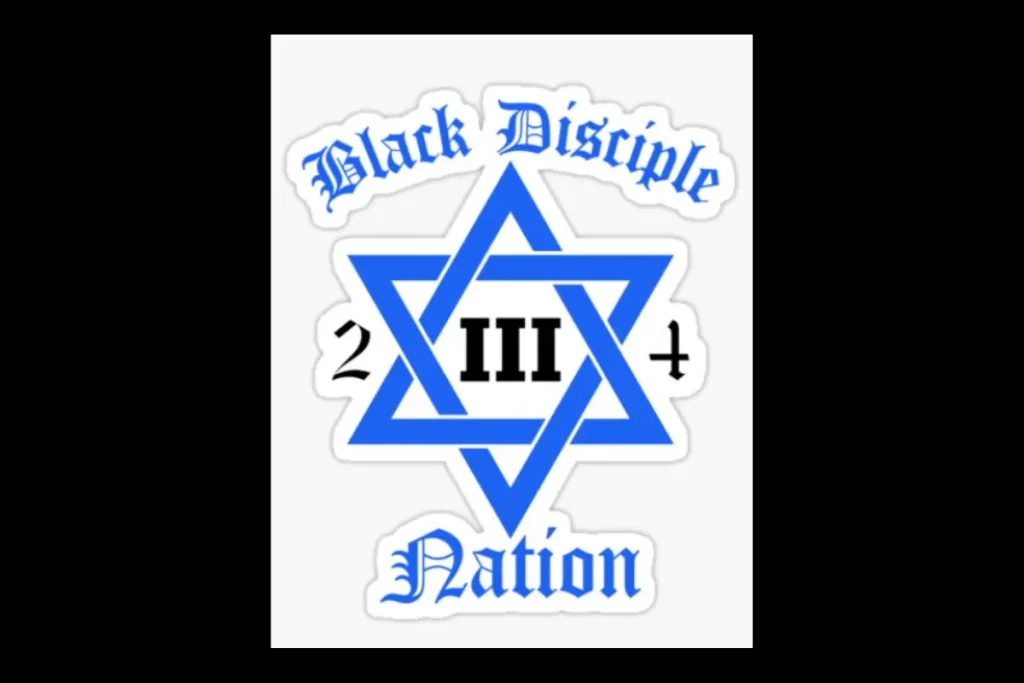
Historically, the groups have used different symbols, colors, and hand signs to distinguish themselves, though these can vary significantly by region and over time. Law enforcement and researchers note that local sets do not always follow the same customs.
Rivalry
The BD–GD rivalry has been one of Chicago’s longest-running gang conflicts.
Contributing factors include:
- Territorial disputes
- Leadership conflicts
- Retaliatory violence between local factions
- Competition over influence and criminal enterprises
Not every BD or GD set is in active conflict, however. Relationships can vary by neighborhood and city, and local alliances sometimes differ from historical patterns.
Organization
Both organizations are decentralized. Rather than functioning as a single nationwide hierarchy, they consist of numerous local “sets” or chapters with varying degrees of independence. Some retain stronger organizational structures than others.
Law Enforcement
Both organizations have been the subject of numerous federal and state investigations involving allegations such as:
- Drug trafficking
- Firearms offenses
- Violent crimes
- Racketeering (RICO) prosecutions
It’s important to note that membership alone does not establish that an individual has committed a crime; criminal liability depends on each person’s own conduct.
Key Difference
The simplest way to understand the distinction is:
- Black Disciples are the original organization founded by David Barksdale.
- Gangster Disciples developed from the same movement but became a separate organization after the split, with Larry Hoover becoming its most prominent leader.
- Despite their shared history, they have generally been rivals for much of the past five decades.
History of the Black Disciples
The Devil’s Disciples
The origins of the Black Disciples are generally traced to the late 1950s and early 1960s, when neighborhood gangs on Chicago’s South Side began merging into larger organizations. One of the most influential of these groups became known as the Devil’s Disciples, led by David Barksdale.
Instead of operating as isolated neighborhood gangs, these organizations increasingly sought larger alliances that could provide greater influence and protection within rapidly changing neighborhoods. The Devil’s Disciples became one of the strongest organizations in this period and laid the foundation for what would later become the Black Disciples Nation.
Formation of the Black Disciples Nation
By 1966, the organization had expanded and became widely known as the Black Disciples Nation (BDN).
The transition reflected more than a name change. The group had grown in size, developed recognizable symbols and internal traditions, and established a stronger identity among Chicago’s South Side street organizations.
David Barksdale emerged as the defining figure of this era. Known throughout Chicago as King David, he became the individual most closely associated with the creation and expansion of the Black Disciples. Although local leadership varied between neighborhoods, Barksdale’s influence helped shape the organization’s early identity and remains central to its history.
The BGDN Merger
One of the most important events in the organization’s history occurred in 1969.
David Barksdale and Larry Hoover, leader of another influential Chicago street organization known as the Supreme Gangsters, agreed to unite their respective groups.
The merger created the:
Black Gangster Disciples Nation (BGDN)
At the time, the merger was intended to reduce conflict between the two organizations while increasing their influence throughout Chicago. For several years, the Black Gangster Disciples Nation became one of the city’s most powerful street organizations, combining members who had previously operated separately.
Although the merger initially strengthened the organization, it also created leadership tensions that would later contribute to its breakup.
The Death of King David
David Barksdale’s influence ended with his death in 1974.
Several years earlier, Barksdale had been seriously wounded in a shooting that caused long-term kidney damage. Complications from those injuries eventually led to kidney failure, and he died at the age of twenty-seven.
Despite his relatively short life, King David became the symbolic founder of the Black Disciples. His legacy continues to be referenced in discussions of the organization’s history, even though the group changed significantly after his death.
The Split Between the Black Disciples and Gangster Disciples
Following Barksdale’s death, disagreements over leadership and the future direction of the organization became increasingly significant.
Over time, the Black Gangster Disciples Nation fractured into two separate organizations:
- Black Disciples (BD)
- Gangster Disciples (GD)
Although both organizations shared common origins, they gradually developed separate identities, leadership structures, and neighborhood alliances. What began as a unified organization eventually became one of Chicago’s best-known gang rivalries.
The split reshaped gang dynamics across the city and continues to influence discussions of Chicago street organizations decades later.
Expansion During the 1980s and 1990s
Following the split, the Black Disciples continued expanding across several South Side neighborhoods.
Federal investigators later alleged that some local leaders oversaw drug trafficking operations, while violence between neighborhood factions brought increased law enforcement attention. Throughout the 1980s and 1990s, the organization became the subject of numerous criminal investigations involving narcotics distribution, racketeering, firearms offenses, and violent crime.
During this period, media coverage significantly increased public awareness of the Black Disciples, making the gang one of the most recognizable street organizations in Chicago.
The Modern Black Disciples
Today, researchers generally describe the Black Disciples as a decentralized network of neighborhood sets rather than a single organization operating under one consistent chain of command.
Individual sets often maintain their own local leadership, neighborhood relationships, and rivalries. While the Black Disciples continue to share a common historical identity, their day-to-day organization varies considerably from one neighborhood to another.
This decentralized structure helps explain why reports about the gang sometimes appear contradictory. Leadership, alliances, and even local customs can differ depending on the particular set being discussed.
Black Disciples History Timeline
| Year | Event |
|---|---|
| Late 1950s | Devil’s Disciples emerge on Chicago’s South Side |
| 1966 | Black Disciples Nation formally develops |
| 1969 | Merger with Larry Hoover’s Supreme Gangsters creates the Black Gangster Disciples Nation (BGDN) |
| 1974 | David Barksdale (King David) dies |
| Late 1970s | BGDN gradually splits into the Black Disciples and Gangster Disciples |
| 1980s | Expansion into additional Chicago neighborhoods |
| 1990s | Major federal investigations increase public attention |
| 2000s–Present | Organization operates primarily as decentralized neighborhood sets |
Symbols, Signs, and Colors
Recognized symbols
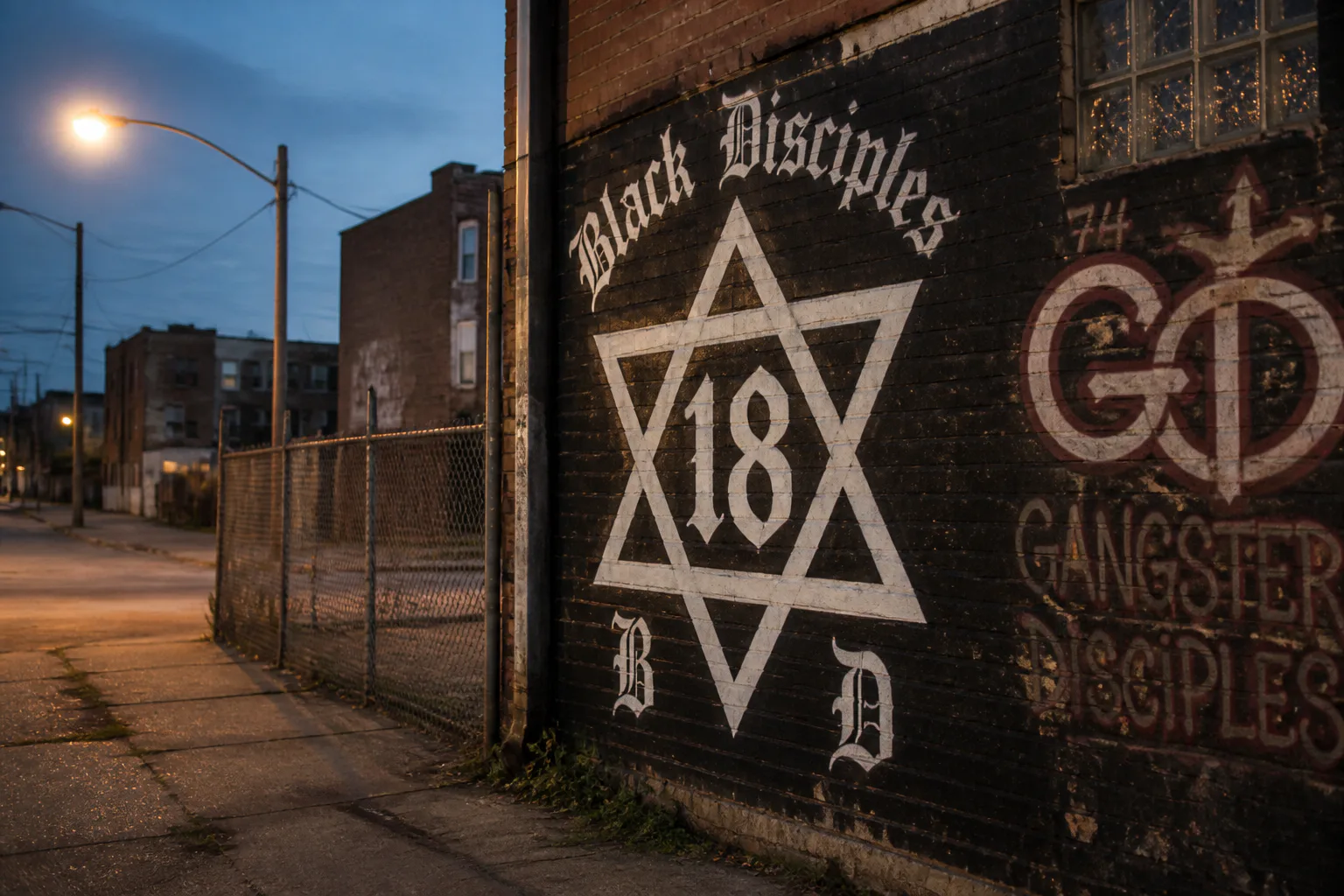
- A six-pointed star
- A crown
- A heart
- A star
- A sword
- A pitchfork
- Wings
- A devil’s tail
- The number 78
Gang signs and visual identity
When people ask about the black disciples gang sign or black disciples sign, they are usually referring to hand gestures or arrangements of fingers used as identifiers. Specific hand signs can vary by neighborhood and era, and they often appear alongside drawings, tattoos, or graffiti built around the symbols listed above. These markers are used to claim identity, signal affiliation, or disrespect rivals.
Colors, bandanas, and emoji
- No official bandana color was verified in the provided material.
- No official emoji system was verified in the provided material.
- Online references to colors or emojis often mix rumor, local variation, and social-media shorthand.
That matters because gang symbolism is often flattened online into simple color charts, when the on-the-ground meaning is usually more specific and more localized. Lists of blood gang names and color associations are often treated as universal by casual readers, but Chicago gangs follow their own histories and symbol systems.
Organizational Structure
Unlike corporations or government agencies, the Black Disciples have never operated under a single permanent chain of command. Researchers and law enforcement generally describe the organization as a decentralized network of neighborhood-based sets, with leadership varying by location and era.
During the group’s early history, influential figures such as David Barksdale helped unify multiple neighborhood gangs under one identity. As the organization grew, authority became increasingly distributed among local leaders who oversaw their own territories.
Today, there is no publicly documented nationwide leadership structure. Instead, individual sets typically manage their own activities while sharing a common historical identity and symbolism.
Historical leadership hierarchy
Although titles have changed over time, historical accounts suggest the organization generally followed a structure similar to:
- Senior leadership responsible for broader organizational decisions
- Influential neighborhood leaders overseeing individual sets
- Local coordinators and trusted members
- General members
- Prospective recruits and associates
The exact responsibilities associated with these positions varied by neighborhood and time period. As law enforcement pressure increased and the organization became more decentralized, local sets gained greater independence.
The role of neighborhood sets
A set is a local chapter or neighborhood-based faction operating under the broader Black Disciples identity.
Each set typically develops its own:
- Local leadership
- Territory
- Alliances
- Rivalries
- Neighborhood traditions
This explains why reports about the Black Disciples can sometimes appear inconsistent. A relationship that exists in one neighborhood may not exist elsewhere, and conflicts often involve individual sets rather than the organization as a whole.
Modern organization
Modern researchers generally describe the Black Disciples as far less centralized than during their early decades.
Instead of following one citywide chain of command, many neighborhood sets operate with considerable autonomy. While they continue to identify with the Black Disciples’ history and symbols, local leadership often determines day-to-day decisions.
This decentralized model is common among long-established Chicago street gangs and reflects decades of organizational change, law enforcement pressure, and shifting neighborhood dynamics.
Historical Leaders of the Black Disciples
Understanding the Black Disciples also means understanding the individuals most commonly associated with the organization’s development. While many local leaders have influenced individual sets, only a small number of figures are consistently recognized in historical accounts.
David Barksdale (King David)
David Barksdale remains the most important figure in Black Disciples history.
Known throughout Chicago as King David, he helped organize several neighborhood gangs into what became the Black Disciples Nation during the 1960s. His leadership shaped the organization’s early identity, and his name continues to be associated with the group’s origins decades after his death.
Although his influence ended in 1974, Barksdale remains the symbolic founder of the Black Disciples.
Larry Hoover and the BGDN era
Although Larry Hoover is most closely associated with the Gangster Disciples, his role is essential to understanding Black Disciples history.
In 1969, Hoover and David Barksdale agreed to merge their organizations, creating the Black Gangster Disciples Nation (BGDN).
For several years, both leaders shared responsibility within the merged organization before internal disagreements eventually led to the split that produced the modern Black Disciples and Gangster Disciples.
Because of this shared history, Hoover is often discussed alongside King David when explaining the origins of both organizations.
Mickey Bull
Another historical figure frequently mentioned in public reporting is Mickey Bull.
Following the organization’s early decades, Mickey Bull became associated with leadership during a period when neighborhood authority, organizational identity, and internal hierarchy were changing significantly.
Like many historical gang leaders, his influence was strongest within particular periods rather than across the organization’s entire history.
Later leadership
Over time, additional neighborhood leaders emerged as influential figures within different Black Disciples sets.
Unlike the organization’s earliest years, however, modern leadership has generally been more localized. Instead of one widely recognized leader, authority is often tied to individual neighborhoods and local organizations.
For that reason, public searches for a single “current Black Disciples leader” usually oversimplify how the organization operates today.
Geographic Presence
Although the Black Disciples are most closely associated with Chicago, their name has appeared in law enforcement reporting outside Illinois as members relocated and neighborhood affiliations spread through migration and prison systems.
Chicago
Chicago remains the historical center of the Black Disciples.
The organization has long been associated with several South Side neighborhoods, where many of its earliest sets developed.
Among the neighborhoods most frequently discussed in historical reporting are:
- Woodlawn
- Englewood
- Washington Park
- Greater Grand Crossing
- Parkway Gardens (because of its connection to Chicago drill music)
The importance of these neighborhoods has changed over time, and not every area has maintained the same affiliations across different decades.
Presence outside Chicago
Over the years, law enforcement agencies have reported Black Disciples-affiliated members or local sets in several other states.
Reported activity has included parts of:
- Illinois
- Indiana
- Wisconsin
- Mississippi
- Tennessee
- Georgia
The scale and organization of these groups vary considerably. Outside Chicago, many are significantly smaller than the organization’s historical South Side presence.
Neighborhood identity
Unlike nationally centralized gangs, the Black Disciples are heavily influenced by neighborhood identity.
In many cases, residents identify more strongly with a specific local set than with the broader organization itself.
As a result:
- Alliances often depend on neighborhood relationships.
- Rivalries may differ from one community to another.
- Local history frequently matters more than citywide labels.
Understanding this neighborhood-based structure helps explain why two Black Disciples sets may have different allies, different rivals, and different local traditions despite sharing the same historical identity.
Notable Historical Events
Several events have significantly shaped public understanding of the Black Disciples over the past several decades.
Formation of the Black Gangster Disciples Nation (1969)
The merger between David Barksdale’s Black Disciples and Larry Hoover’s Supreme Gangsters created one of Chicago’s largest street organizations and permanently influenced the history of both the Black Disciples and Gangster Disciples.
Death of King David (1974)
David Barksdale’s death marked a turning point in the organization’s history, contributing to leadership struggles that eventually led to the separation of the Black Disciples and Gangster Disciples.
Federal investigations during the 1990s
Large-scale federal investigations into alleged drug trafficking and racketeering increased national awareness of the Black Disciples and contributed to several high-profile criminal prosecutions involving alleged leaders and local sets.
Rise of Chicago drill music
Beginning in the early 2010s, Chicago drill music introduced millions of people to neighborhood identities that had previously been known mainly within the city.
Although the music often referenced local rivalries and street culture, artistic expression should not automatically be interpreted as a direct representation of organizational structure or membership.
Rivalries
Black Disciples vs Gangster Disciples
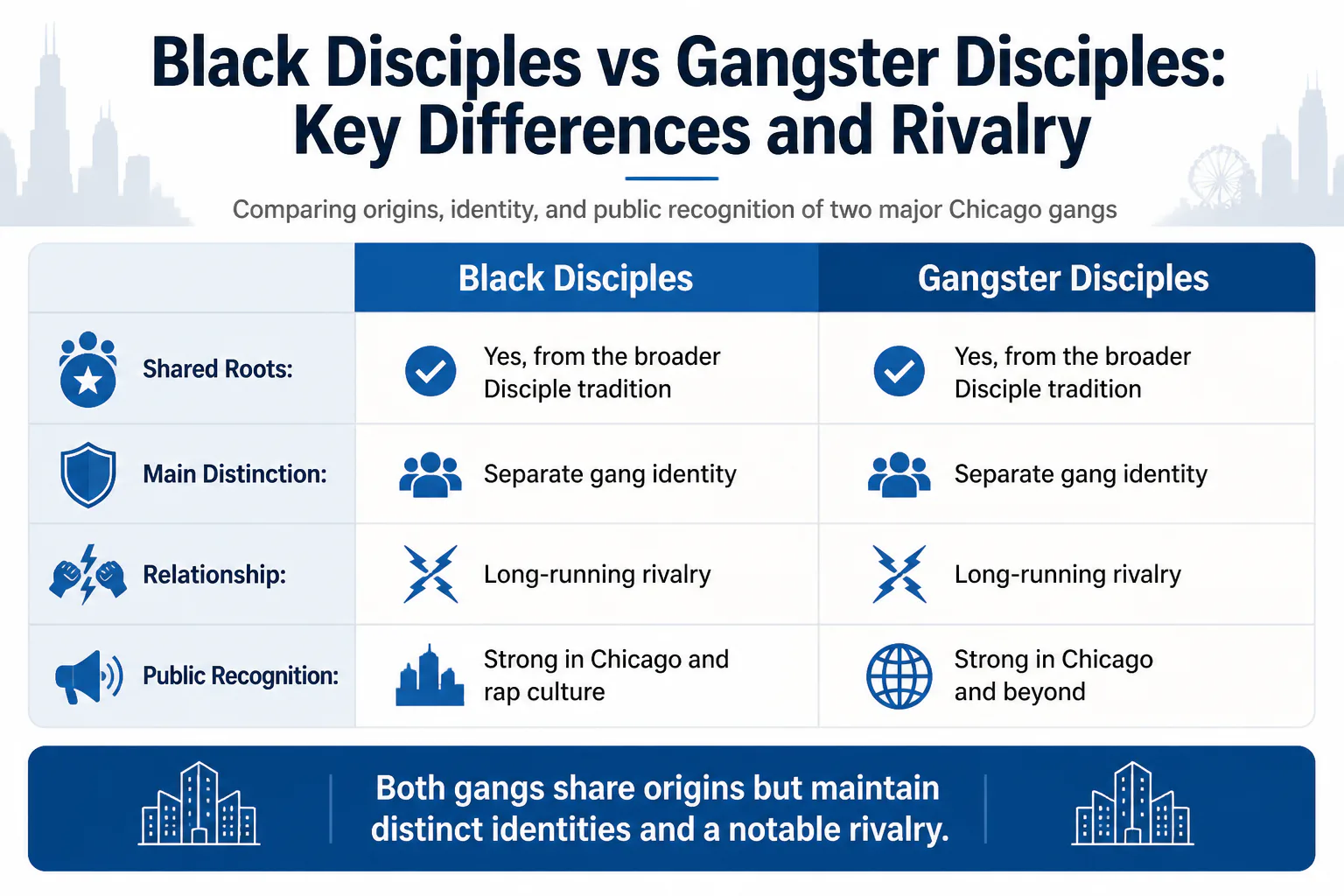
The rivalry between the Black Disciples and the Gangster Disciples is one of the most important feuds in Chicago gang history. Both groups came out of the broader Disciple orbit, but their separation turned shared roots into a prolonged conflict. That split shaped street alliances, neighborhood violence, and the way many outsiders learned the difference between the two groups.
Allies and neighborhood ties
Alliances have shifted over time and usually depend more on local enemies than on broad citywide rules. In some areas, the Black Disciples have aligned with nearby factions for practical reasons tied to turf and mutual opposition. In public conversation, gangs are sometimes grouped as if they were fixed families like mafia gang names, but Chicago alliances often change block by block.
- Shared roots do not prevent rivalry.
- Alliances can change by neighborhood.
- Local conflicts often matter more than citywide labels.
| Topic | Black Disciples | Gangster Disciples |
|---|---|---|
| Shared roots | Yes, from the broader Disciple tradition | Yes, from the broader Disciple tradition |
| Main distinction | Separate gang identity | Separate gang identity |
| Relationship | Long-running rivalry | Long-running rivalry |
| Public recognition | Strong in Chicago and rap culture | Strong in Chicago and beyond |
Cultural Impact
Chicago rap connection
The Black Disciples gained an unusual level of cultural visibility because of Chicago drill music. Artists associated with BD-linked neighborhoods, especially Chief Keef, Lil Durk, and King Von, helped bring local street identities into national and international view. Their lyrics, affiliations, feuds, and public images made the gang’s name familiar far beyond Chicago.
Chief Keef, Lil Durk, and King Von
Chief Keef is one of the first names people connect to the Black Disciples because his rise coincided with drill’s breakout moment. Lil Durk and King Von are also frequently discussed in relation to BD-linked circles, neighborhood alliances, and the way street politics shaped rap narratives. That does not mean every cultural reference is a formal gang statement, but it does show how deeply local gang identity influenced a major musical movement.
Beyond music
The gang’s cultural footprint now extends into documentaries, true-crime coverage, online debates, and fan interpretations that often blur fact and image. That is why any account of black disciples rappers has to separate documented neighborhood ties from entertainment mythology. The music made the name visible, but it also made the history easier to distort.
Beliefs, Religion, and Identity
Religion and prayer
Questions about black disciples religion usually come from references to internal language, prayers, and slogans. One phrase often mentioned is “I am what I am,” which appears in discussions of Black Disciple prayer or affirmational language. These expressions function more as organizational identity and ritual language than as evidence of a mainstream religious denomination.
What do Black Disciples believe in?
The gang’s core beliefs are tied to loyalty, group identity, hierarchy, and neighborhood allegiance rather than a formal theology. Like many long-standing gangs, the Black Disciples developed codes, symbolic language, and internal traditions that can sound religious to outsiders. That does not make the organization a religion in the conventional sense.
Blood or Crip?
No, the Black Disciples are not Bloods or Crips. They are a distinct Chicago-based gang with their own history, symbols, and organizational lineage. People often ask this because Bloods and Crips are the best-known gang categories nationally, but that framework does not neatly fit Chicago’s gang map.
Major Court Cases and Federal Investigations
The Black Disciples have been the subject of numerous criminal investigations over the past several decades. Several court cases attracted national attention because they involved allegations of racketeering, narcotics trafficking, or high-profile acts of violence.
These cases are significant because they provide publicly available court records describing the government’s allegations and investigations.
United States v. Derrick White et al.
One of the largest federal prosecutions involving alleged Black Disciples leadership centered on a racketeering investigation in Chicago.
Federal prosecutors alleged that members participated in:
- Drug trafficking
- Racketeering (RICO)
- Firearms offenses
- Violent crimes committed in furtherance of the organization
The case became one of the most frequently cited federal prosecutions involving the Black Disciples because appellate court records summarized the government’s description of the organization’s alleged structure and criminal activities.
United States v. Donnell Jehan
Another significant federal case involved Donnell Jehan, whom prosecutors identified as an influential Black Disciples leader.
Jehan ultimately pleaded guilty to participating in a long-running narcotics conspiracy before later appealing aspects of his sentence.
The case highlighted the extensive federal investigations directed at alleged Black Disciples drug trafficking operations during the 1990s and early 2000s.
The Robert “Yummy” Sandifer Case
Few events brought greater public attention to Chicago youth gangs than the murder of Robert “Yummy” Sandifer.
Sandifer, an 11-year-old Black Disciples member, became the focus of nationwide media coverage after the accidental shooting death of a 14-year-old girl.
While sought by police, Sandifer was himself murdered by older gang members who feared he would cooperate with investigators.
The case became an enduring symbol of juvenile gang violence and prompted widespread discussion about youth crime, community intervention, and gang recruitment.
The FBG Duck Federal Murder Trial
In 2020, the fatal shooting of Chicago rapper Carlton “FBG Duck” Weekly received extensive national media attention.
Federal prosecutors later charged several defendants with murder in aid of racketeering, alleging that the killing was connected to an ongoing gang-related conflict involving Black Disciple factions and rival groups.
The convictions further illustrated how federal authorities increasingly used racketeering statutes in prosecutions involving organized gang violence.
Why Federal Authorities Used RICO
Many of the most significant prosecutions involving the Black Disciples relied on the Racketeer Influenced and Corrupt Organizations Act (RICO).
Rather than prosecuting isolated crimes individually, RICO allows prosecutors to allege that multiple criminal acts were committed as part of a continuing criminal enterprise.
Federal investigators have used RICO in cases involving alleged:
- Drug trafficking networks
- Firearms offenses
- Witness intimidation
- Organized violent crime
- Money laundering
- Criminal conspiracies
Because of these investigations, the Black Disciples became one of the most frequently discussed Chicago gangs in federal court records.
Common Myths and Misconceptions
Public interest in the Black Disciples has grown significantly because of documentaries, social media, and Chicago drill music. As a result, several misconceptions have become common.
Myth: The Black Disciples have one national leader.
Reality: Researchers generally describe the organization as a decentralized network of neighborhood sets rather than a single nationwide organization.
Myth: Every rapper associated with a BD neighborhood is a confirmed member.
Reality: Artists often reference neighborhood identity, personal history, or local culture. Public associations should not automatically be interpreted as verified organizational membership.
Myth: All Black Disciples sets operate the same way.
Reality: Leadership, rivalries, and alliances vary considerably from one neighborhood to another.
Myth: The Black Disciples are part of the Bloods or Crips.
Reality: The Black Disciples developed independently in Chicago and have their own history, organizational lineage, and symbolism.
Cultural Impact
Chicago Drill Music and Public Recognition
For many people outside Chicago, the first time they heard the name Black Disciples was through the rise of Chicago drill music during the early 2010s.
Unlike previous rap movements, drill music frequently referenced real neighborhoods, local rivalries, and the experiences of growing up in communities affected by poverty and violence. As the genre gained national and international popularity, the names of Chicago neighborhoods and local street organizations became familiar to audiences far beyond the city.
This exposure significantly increased public curiosity about the Black Disciples, even among people with little prior knowledge of Chicago’s gang history.
Chief Keef, Lil Durk, and King Von
Several of drill music’s most recognizable artists have been publicly associated with neighborhoods historically linked to the Black Disciples.
Among the names most frequently discussed are:
- Chief Keef
- Lil Durk
- King Von
- Lil Reese
- Fredo Santana
These associations are often based on artists’ own public statements, neighborhood backgrounds, or media reporting. However, they should not automatically be interpreted as confirmation of formal gang membership.
Many artists describe their neighborhoods and life experiences without representing or speaking on behalf of any organization. Understanding that distinction is important when separating documented history from entertainment narratives.
Beyond Music
The Black Disciples have also appeared in:
- News reporting
- True-crime documentaries
- Books about Chicago gangs
- Academic research
- Podcasts
- Online discussions
- Television documentaries
Because of this widespread attention, the organization’s public image is often shaped as much by media coverage as by historical documentation.
Some online discussions simplify or exaggerate events for entertainment, making it important to rely on credible reporting and historical sources when researching the organization’s history.
Beliefs, Identity, and Internal Culture
Organizational Identity
People frequently search for topics such as “Black Disciples religion,” “Black Disciples prayer,” or “Black Disciples beliefs.”
These questions usually arise because historical accounts describe internal slogans, symbolic language, and rituals that resemble religious terminology.
Researchers generally view these practices as expressions of organizational identity rather than evidence of membership in a traditional religious denomination.
Like many long-standing street organizations, the Black Disciples developed their own language, traditions, and codes of conduct that reinforced loyalty and group identity.
“I Am What I Am”
One phrase often associated with discussions of the Black Disciples is:
“I am what I am.”
The phrase has appeared in public discussions of organizational language and internal identity.
Although outsiders sometimes interpret expressions like this as religious, they are more accurately understood as part of the organization’s historical symbolism and internal culture rather than formal religious doctrine.
Are the Black Disciples Bloods or Crips?
No.
The Black Disciples developed independently in Chicago and are not part of either the Bloods or the Crips.
This question is common because Bloods and Crips are among the best-known gangs in the United States. Chicago, however, has its own unique gang history that developed separately from the street organizations originating in Los Angeles.
Frequently Asked Questions
Who founded the Black Disciples?
The Black Disciples are most commonly associated with David Barksdale, known as King David, who helped organize the group during the 1960s in Chicago.
When were the Black Disciples founded?
Most historical sources identify 1966 as the founding year of the Black Disciples Nation, although the organization’s roots extend to earlier neighborhood groups collectively known as the Devil’s Disciples.
What does “BD” stand for?
BD is the commonly used abbreviation for Black Disciples.
Where did the Black Disciples originate?
The organization originated on Chicago’s South Side, where several neighborhood gangs merged during the 1960s.
Are the Black Disciples still active?
Yes.
Law enforcement agencies and researchers continue to report the presence of Black Disciples-affiliated neighborhood sets, particularly in Chicago. Modern activity is generally described as decentralized, with local sets operating independently rather than under a single centralized leadership structure.
Who is the current leader of the Black Disciples?
There is no publicly verified single leader representing the entire organization.
Researchers generally describe the modern Black Disciples as a decentralized network of neighborhood-based sets with local leadership rather than one citywide command structure.
What are Black Disciples sets?
A set is a neighborhood-based chapter operating under the broader Black Disciples identity.
Individual sets often maintain their own leadership, territory, alliances, and rivalries.
Why are the Black Disciples and Gangster Disciples rivals?
Both organizations were once united as the Black Gangster Disciples Nation (BGDN).
Following leadership disputes and organizational changes after David Barksdale’s death, the alliance eventually split into two separate organizations whose rivalry became one of Chicago’s best known.
What neighborhoods are historically associated with the Black Disciples?
Historical reporting most commonly connects the organization to several Chicago South Side neighborhoods, including:
- Woodlawn
- Englewood
- Washington Park
- Greater Grand Crossing
Neighborhood affiliations have changed over time, and local conditions vary considerably.
Are all Chicago drill rappers Black Disciples?
No.
Many artists are connected to particular neighborhoods or local communities, but that does not necessarily indicate formal membership in any organization.
Each artist’s background should be evaluated individually rather than assumed from geography or musical style.
Key Facts at a Glance
| Topic | Summary |
|---|---|
| Founded | 1966 (roots trace to the late 1950s Devil’s Disciples) |
| Founder | David Barksdale (“King David”) |
| Origin | Chicago, Illinois |
| Historical merger | Black Gangster Disciples Nation (1969) |
| Organization today | Decentralized neighborhood sets |
| Most recognized rival | Gangster Disciples |
| Public visibility | Crime reporting, federal investigations, and Chicago drill music |
| National affiliation | Independent Chicago street organization (not Bloods or Crips) |
Conclusion
The Black Disciples remain one of the most historically significant street organizations to emerge from Chicago. Their story spans more than half a century, beginning with neighborhood gangs that united during the 1960s, continuing through the formation of the Black Disciples Nation and the Black Gangster Disciples Nation, and evolving into the decentralized network of neighborhood sets that researchers describe today.
Understanding the Black Disciples requires more than recognizing names, symbols, or popular culture references. Their history reflects broader issues involving urban development, neighborhood identity, law enforcement, and community change in Chicago. While media coverage and drill music have brought unprecedented public attention to the organization, they have also contributed to misconceptions that often blur documented history with myth.
Looking at the Black Disciples through historical research, court records, and credible reporting provides a more accurate understanding of how the organization developed, why its rivalry with the Gangster Disciples became so influential, and why it continues to be discussed decades after its formation.